Entry 004
Station 7: Animals from the Cal State LA Archives
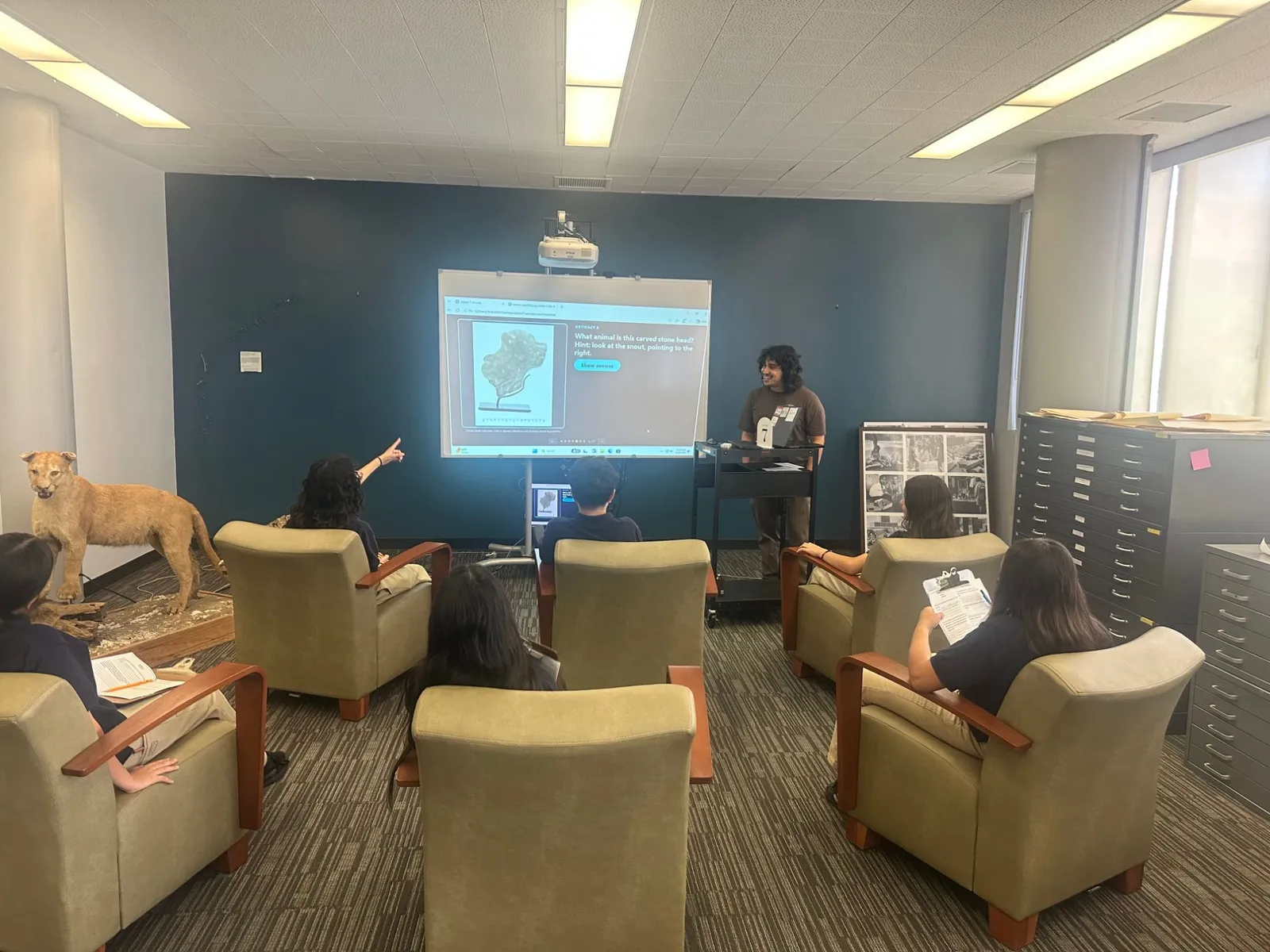
Every object in this post lives on the Cal State LA campus.
Luis works at the Special Collections and Archives at Cal State LA. For this project, the job was to gather images of objects from the collection for a group of 7th grade students. Those images became the presentation below.
AI-assistance disclosure: this post was drafted by Claude Opus 5.5, an AI model made by Anthropic. It wrote a first draft of what Luis would say, working from the presentation, and Luis reviewed it before publishing. It also set up the embed. The images, the project and the presentation are Luis’s.
Why Luis built it
The photo at the top shows the presentation in action at Special Collections, with the cougar standing in for the jaguar. It’s one station in a set, Station 7, and its subject is animals in ancient Mesoamerica. The big idea is that animals weren’t just part of nature. They were a link between people and the divine.
Luis didn’t want the students to just read labels. Each object is a question first. What do you see in this carved stone? Where is the snake’s mouth? How many legs does this bird have? The answer stays hidden until someone presses the button. Ancient artists hid animals inside other shapes, and the fun is in finding them yourself.
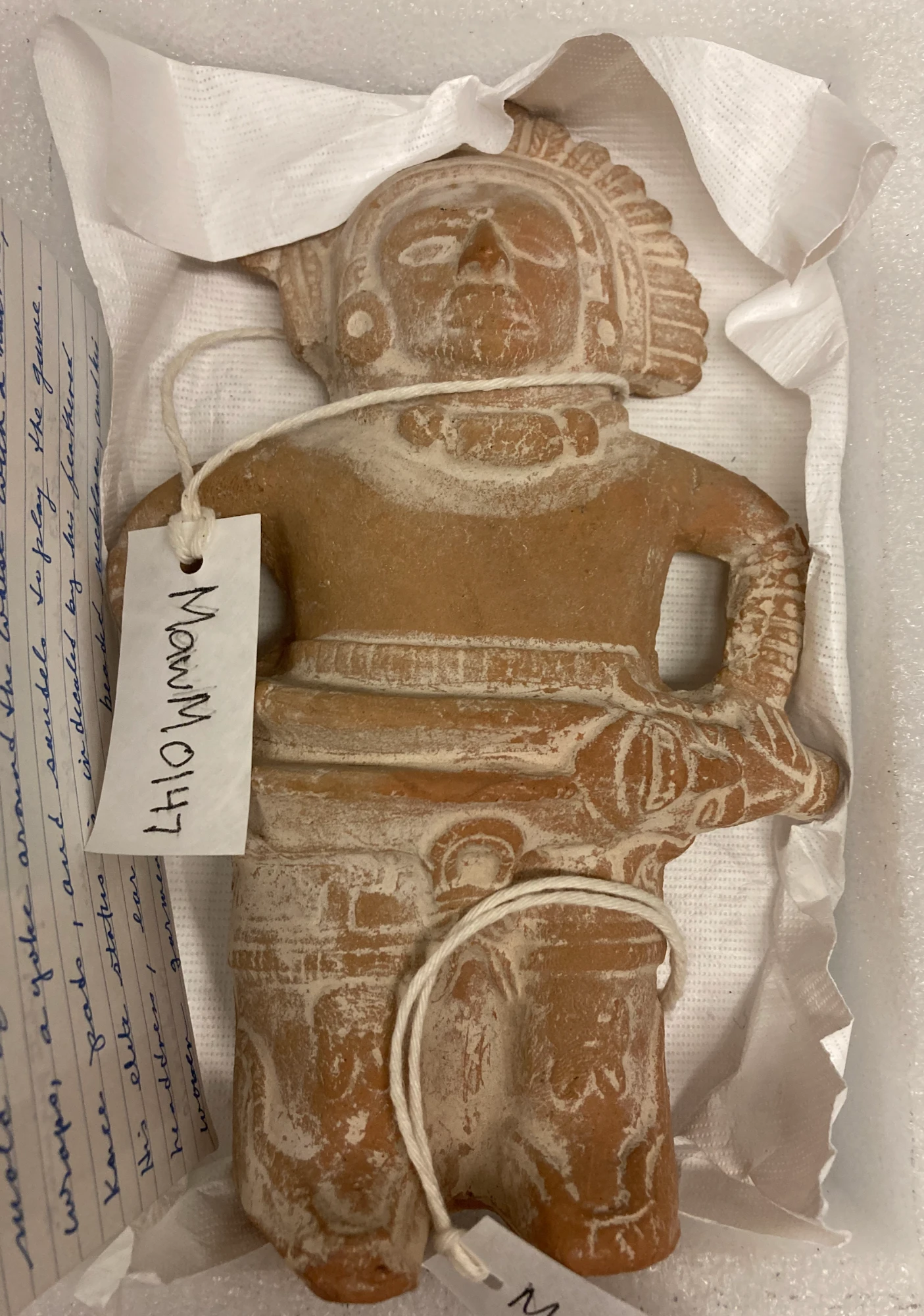
The other thing Luis wanted the students to understand: these aren’t photos pulled from the internet. They’re objects from the Cal State LA archive itself, photographed in the boxes they’re stored in, with their catalog tags still tied on.
The presentation
Use the arrow buttons at the bottom to move through the slides. To use the keyboard instead, click inside the slides first, then press the left and right arrows, and Space or Enter to show an answer. Press F for full screen.
Open the presentation in its own tab
What’s in the collection
All of these come from the MAW Collection in the Cal State LA Special Collections and Archives:
-
Two carved stone hachas from the Maya of Guatemala (MawM0145, MawM0146). One shows a skull, a bird of prey, and a jaguar at once, depending on how you turn it. The other hides a descending serpent.
-
A stone yoke (MawM0183), the heavy U-shaped belt worn in the Mesoamerican ballgame.
-
A clay ballplayer wearing a yoke (MawM0147), below. He shows how a yoke was worn.
-
A clay figure (MawM0154), seated and holding a small round-eyed face in its lap.
-
A stone macehead from Colima, Mexico (MawM0194), about 2,000 years old and only 3 inches high. It’s carved as a dog, and when you flip it upside down it becomes a horned frog.
-
A red clay horned frog (M-1992.10).
-
A harpy eagle effigy vessel from Cholula, Mexico (MawM0100), almost 12 inches tall, made between about 1250 and 1521 CE.
That’s a ballgame, a jaguar, a serpent, a dog that turns into a frog, and an eagle, all in one archive on a public university campus in Los Angeles. If you’re a student, a teacher, or just curious, the Special Collections and Archives is worth a visit.